You picked up your phone for one thing, and twenty minutes later you’re still scrolling. It happens to everyone. This session is for the moment you notice it and want to get back to work.
The most important step happens before you press play, when you put your phone somewhere you can’t see it. After that, this session gives you long stretches of work with breaks you can trust. We build every session from what the research says about each sound, and this page shows what’s in this one and how strong the evidence is for each part, including where it’s thin.
How to use it
- Put your phone in another room, or at least face down and out of reach. Turn notifications off if you can. This step matters more than anything in the sound.
- Pick one task. If you like, write it in the YouTube comments so it’s real.
- Press play. After a short voice intro, the first 50 minutes start.
- Work until the chime. A soft cue plays two minutes before each break, so you can find a stopping point.
- In the 10-minute break, stand up, drink some water and look away from the screen. If you want to check your phone, this is the time. The next chime brings you back.
The full session is 3 hours: three rounds of 50 minutes of focus and a 10-minute break. You don’t have to do all three. The chapters in the video description let you jump to any round.
What’s in the sound, and why
Soft work music with a slow beat
The music is warm electric-piano chords that change slowly, with a gentle beat underneath. There are no lyrics and no speech in it, apart from the short spoken intro at the very start.
A large review of the research found that music with lyrics hurts reading, while instrumental music makes little difference either way (Vasilev et al., 2018). The music’s job is to make three hours easier to sit through without pulling your attention away. On its own, it doesn’t boost focus. The slow beat is there because many people find a steady pulse easier to work to than music that floats. That’s a choice of taste, not a research finding.
Evidence: strong (for “no lyrics or speech”, not for the music boosting focus). What the research says about music without lyrics.
Light pink noise underneath
Under the music there’s a little pink noise, a soft, even hiss like distant rain. A 2024 review that pooled the lab studies found that white or pink noise gave a small boost to attention for people with ADHD or high ADHD traits, and slightly hurt focus for people without them (Nigg et al., 2024). That’s why there’s only a little of it here. If noise usually bothers you, try one of the other sessions instead.
Evidence: moderate, with a small effect, and it can go the other way for some people. What the research says about pink noise.
Fixed breaks and a clear chime
The breaks come at set times, and a clear chime marks every change, so you don’t have to keep checking the clock. In one study with students, fixed breaks were linked to less tiredness than breaks people chose for themselves, with the same amount of work done (Biwer et al., 2023). The study didn’t test 50-minute blocks or the two-minute cue. Those are our choices for a long session.
Evidence: weak to moderate, one study.
A brain in a tunnel, and a big timer
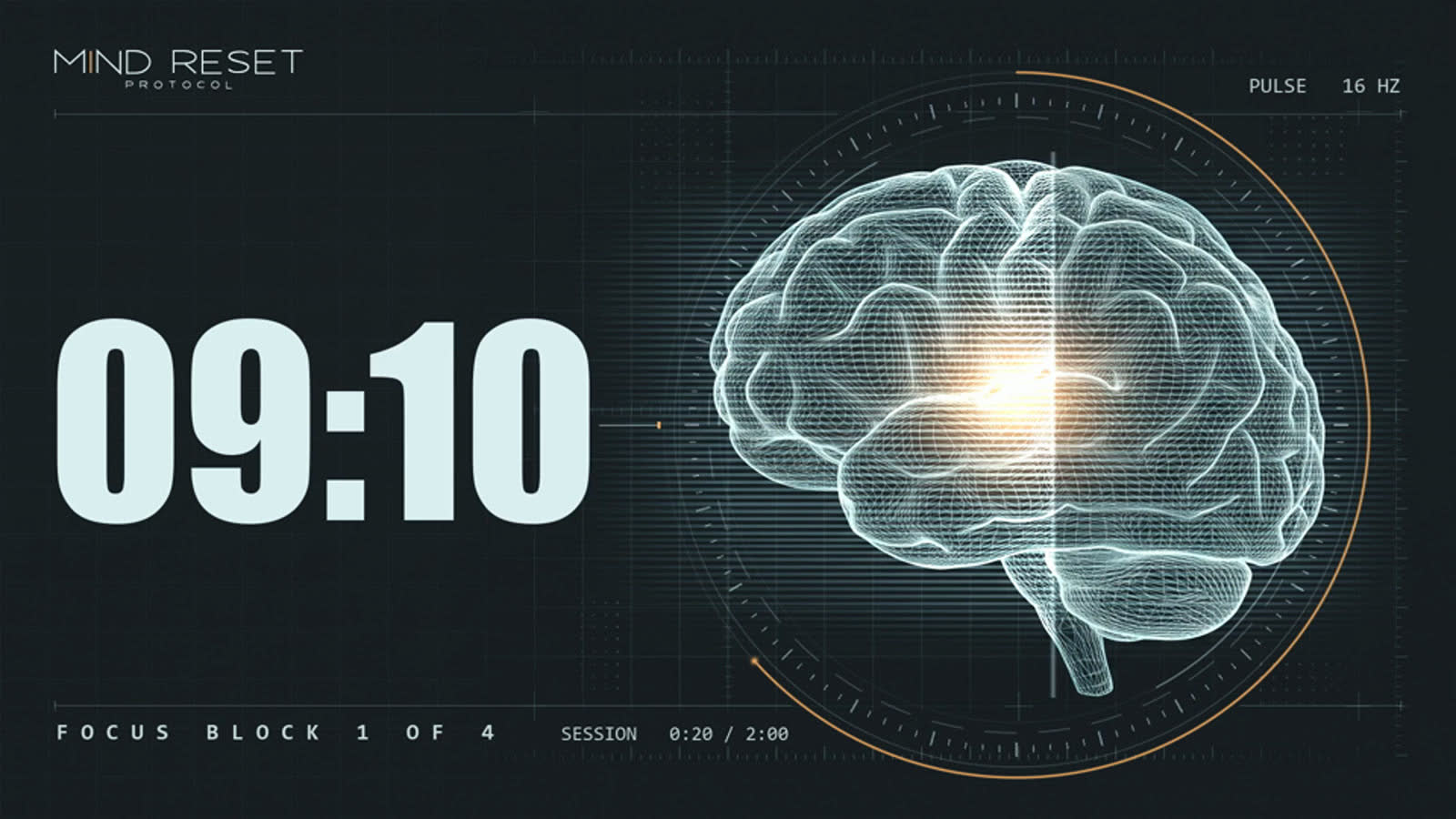
On screen, a 3D brain made of points turns slowly inside an endless tunnel of rings. Through each focus block, small molecules gather from the rings and land on the brain, and it warms to amber as the block goes on. It’s a picture of your work adding up, nothing more. In the break the screen goes quiet and a big countdown takes the centre. A soft tick plays once a second.
Time can be hard to feel when you’re deep in a task, or deep in a feed. Differences in how people with ADHD perceive time are well documented in research, mostly in children and teenagers (Zheng et al., 2022). A visible timer is a simple, low-risk way to make the time in front of you feel finite. There’s no trial showing timers fix anything, so we offer it as a sensible aid.
What this session doesn’t do
This is a focus tool, not a treatment. Some people call the habit it’s named after the dopamine scroll, but this session doesn’t change your dopamine or anything else in your brain. It doesn’t treat ADHD or phone overuse, and it doesn’t replace medication or therapy. If you’re looking into ADHD care, please talk to your clinician.
Sources
- Vasilev et al. (2018), Perspectives on Psychological Science: review of studies on music, lyrics and reading. https://eprints.bournemouth.ac.uk/29995/
- Nigg et al. (2024), Journal of the American Academy of Child and Adolescent Psychiatry 63(8): review and meta-analysis of white and pink noise for attention. https://ohsu.elsevierpure.com/en/publications/systematic-review-and-meta-analysis-do-white-noise-or-pink-noise-
- Biwer et al. (2023), British Journal of Educational Psychology: fixed versus self-chosen study breaks. https://pubmed.ncbi.nlm.nih.gov/36859717/
- Zheng et al. (2022): meta-analysis of time perception differences in ADHD in children and adolescents. https://www.caddra.ca/time-perception-deficits-in-children-and-adolescents-with-adhd-a-meta-analysis/
Every sound we use has its own page with the full research: the evidence hub.